
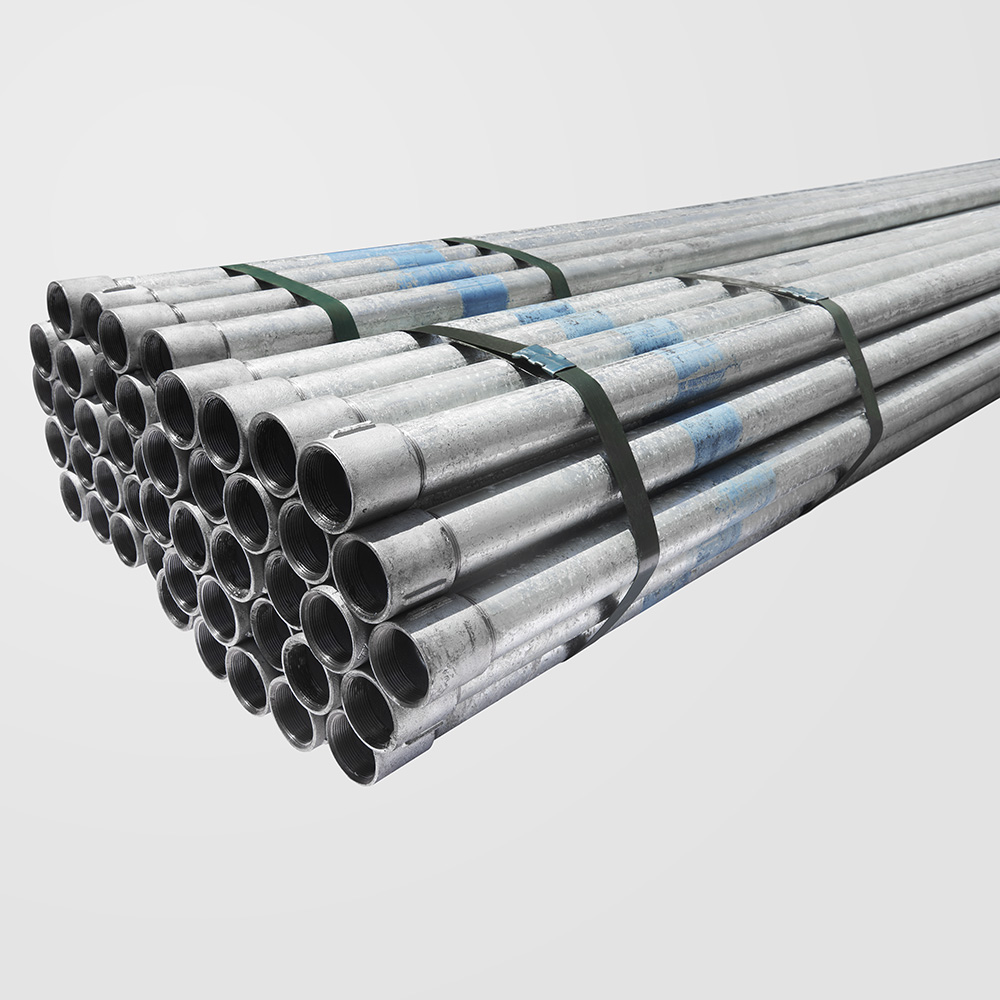
When you are procuring cable management for an M&E installation, the steel conduit standard decides the structural integrity of the run, the corrosion protection around the cable, and whether the pipe and fittings on site actually mate. Tender documents and supplier quotations in Malaysia will usually cite one of three standards: BS 31, MS 275, and MS 61386.
All three govern steel conduit, but they represent a genuine evolution in engineering requirements — from simple dimensional guidelines to performance testing under mechanical and environmental load.
1. BS 31: the imperial legacy
Originating from older British Standards, BS 31 is the legacy specification for steel conduit. It is largely phased out on new build, but it still matters for maintenance, retrofitting, and extensions in older facilities.
- Sizing and threads. Measured in imperial units (¾”, 1”, 1¼”). The thread pitch (threads per inch) differs from modern metric conduit, so BS 31 pipe and fittings are not directly compatible with metric systems without specialised adaptors.
- Wall thickness. Historically specified in Standard Wire Gauge (SWG) rather than an exact millimetre figure, so actual wall could vary with the manufacturer’s tooling.
- Corrosion protection. Finishes were typically categorised as Class A (plain/black enamel) or Class B (galvanised). The galvanising processes under this older standard were less strictly defined than the modern classes below.
Where it still applies: cutting into an existing BS 31 conduit run during a refurbishment. The pitfall is assuming a metric 20 mm coupler will take up on an imperial thread — it will not, and a supplier who cannot confirm the thread form is a risk to your programme.
2. MS 275: the metric baseline
As the construction industry moved to metric, MS 275 (closely mirroring the British BS 4568) became the baseline standard for reliable M&E installations. It introduced stricter uniformity in dimensions and surface treatment.
- Sizing and threads. Fully metric dimensions (commonly 20 mm, 25 mm, 32 mm) using standard ISO metric threads. That standardisation is what lets fittings and accessories from different manufacturers integrate in one run.
- Wall thickness. MS 275 sets strict minimum wall thicknesses — typically 1.6 mm at 20 mm and 25 mm. That thickness is not cosmetic: it is what gives the conduit enough “meat” to be threaded on site without compromising structural strength.
- Corrosion protection. MS 275 introduced the classification system that
Malaysian specifiers know best:
- Class 2 — black enamel, mostly for dry indoor use.
- Class 3 — pre-galvanised sheet steel, moderate protection.
- Class 4 — hot-dip galvanised inside and out: the pipe is dipped in molten zinc after forming, giving a thick, robust coating for industrial and outdoor environments.
The Class 3 vs Class 4 decision is covered on its own in Class 3 vs Class 4 galvanized conduits.
3. MS 61386: the performance-based benchmark
MS 61386 adopts the international IEC 61386 family (cited on some documents as MS IEC 61386) and represents a shift in how conduits are specified. Instead of dictating physical dimensions alone, it focuses on how the conduit performs under mechanical and environmental stress.
- Sizing and threads. Metric (20 mm, 25 mm, and up), maintaining compatibility with standard metric fittings.
- Engineering and wall thickness. Rather than fixing a static 1.6 mm wall, MS 61386 demands the conduit meet mechanical performance thresholds. A conduit must pass crushing tests — heavy-duty classifications require resistance to 1,250 Newtons of compression — and impact tests. The manufacturer engineers the wall thickness and steel grade to pass those load tests, so two “25 mm MS 61386” conduits can have different construction and still conform.
- Corrosion and environmental testing. MS 61386 does not just call for “hot-dip galvanised”; it tests the resilience of that zinc coating under chemical and moisture exposure. The standard also classifies conduits by operating temperature range — client copy cites steel systems rated from −45 °C up to +400 °C — which is why it is the usual choice for high-stakes environments such as data centres.
Technical comparison matrix
| Specification | BS 31 | MS 275 | MS 61386 |
|---|---|---|---|
| System | Imperial (inches) | Metric (millimetres) | Metric (millimetres) |
| Wall thickness | Based on SWG | Prescriptive (e.g. ~1.6 mm at 20 mm) | Performance-driven (crush/impact tests, e.g. 1,250 N heavy duty) |
| Corrosion protection | Basic galvanised / enamel | Class 3 (pre-galv) and Class 4 (hot-dip) | Zinc coatings tested for severe environments |
| Engineering focus | Dimensional compatibility | Standardised metric sizes and threads | Mechanical stress, extreme temperatures, crush resistance |
| Ideal application | Legacy retrofits | Standard commercial electrical routing | Mission-critical infrastructure (data centres, heavy industry) |
Our additional notes for Malaysian procurement
Beyond the client’s breakdown above, three practical points decide submittals here:
- The standard and its revision travel together. Tender documents still cite superseded designations (BS 1387, older BS 4568 editions). If the consultant names “MS 275 Class 4”, supply to that; if the contract names “MS 61386”, supply to that. A written consultant confirmation is worth more than an “equivalent” assumption.
- Conduit is not pipe. GI pipe (BS EN 10255 series) and steel conduit (BS 31 / MS 275 / MS 61386) are governed by different standards even though both appear on an M&E schedule. See the BS EN 10255 steel pipe explainer for the pipe side.
- Confirm the temperature classification per product. The temperature range a standard permits is not a blanket guarantee for every finished conduit; ask for the product’s classification code where the route runs hot or cold.
Where steel conduit sits in the wider route
Steel conduit is one half of the buried-cable decision. Where plastic is enough, HDPE cable duct wins on cost and laying speed; where the cable needs mechanical protection or metallic continuity, steel wins. The full trade-off is in steel conduit vs HDPE cable pipe, and the sizing method — cable OD, fill, bends, and duct banks — is in the electrical conduit sizing guide.
Order steel conduit and its fittings from one system so the threads, couplers, and bends match: browse G.I. pipes and G.I. fittings with your conduit schedule. State the standard, size, and finish class per line and we will quote to the tender requirement.